
Consistent baking doesn’t happen simply because an oven reaches its programmed temperature. Products experience changing conditions as they move through each zone, and those conditions can affect color, texture, moisture and baking time. The steps to determine a baking thermal profile in industrial ovens aren’t overly complicated, but each one contributes to a more accurate understanding of oven performance. A careful process, one bolstered by Reading Thermal technology, helps production teams replace assumptions with useful data.
Start With a Goal That Isn’t Too Broad
Before collecting measurements, the team should decide what it needs to learn. A bakery might be investigating uneven browning, excessive moisture loss, inconsistent texture or differences between products baked on opposite sides of the belt.
The goal shouldn’t be as broad as simply checking whether the oven works. A focused question helps determine which conditions need to be measured. Temperature may be the main concern, but airflow, humidity and heat transfer can also affect the finished product. Choosing the right focus keeps the profiling process practical and prevents teams from collecting information they won’t use.
Prepare Conditions That Won’t Distort the Results
The oven should be operating under normal production conditions before profiling begins. It will need enough time to reach its standard temperature, belt speed and airflow settings. The usual product load should also be considered because an empty oven may behave differently from one running at normal capacity.
Teams should record the recipe, product size, oven settings, belt speed and any other details that may affect the test. These notes don’t need to become a complicated report. They simply provide context so the profile can be repeated and compared with future results.
Choose Sensors That Measure the Right Conditions
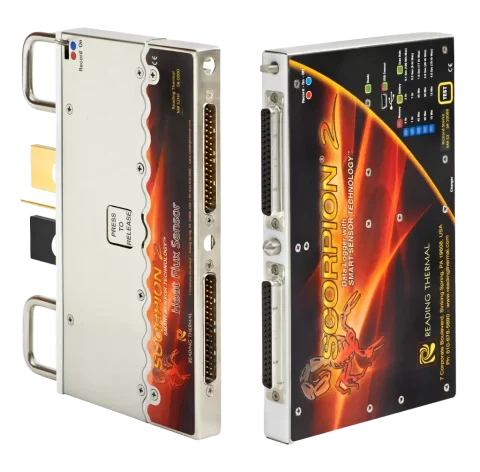
Reading Thermal developed the SCORPION® 2 Profiling System to collect measurements as it travels through an industrial oven with the product. Our Data Logger connects with smart sensors and sensor arrays designed to measure important baking conditions.
A Reading Thermal Temperature Sensor Array can show how heat changes across the oven’s width and through different zones. Other available sensors can measure air velocity, humidity, and heat flux. Since every baking issue isn’t caused by temperature alone, selecting the appropriate sensors helps teams develop a more complete profile.
Run a Test That Doesn’t Interrupt the Process
Once the equipment is prepared, it can travel through the oven along the same path as the product. The protective system shields the Data Logger while the connected sensors collect measurements throughout the baking cycle.
Sensor placement matters because one reading from the center won’t necessarily represent conditions near the oven’s edges. Measuring several positions across the belt can reveal side-to-side differences that may explain uneven products. Teams may also repeat the test to confirm that an unusual result wasn’t caused by a temporary production change.
Review Patterns That Can’t Be Seen From Outside
After the run, teams can review the collected profile and compare conditions across the oven. They’ll want to look for unexpected temperature changes, uneven airflow, humidity differences, or shifts in heat transfer.
The most useful findings are often patterns rather than individual readings. A repeated drop in one zone or a consistent difference across the belt may point to a setting, fan, damper, burner or maintenance issue. Product observations should also be compared with the profile so the data remains connected to actual baking quality.
Your Profile Won’t Matter Without Action
A baking thermal profile becomes valuable when it leads to informed decisions. After identifying a likely issue, teams can make one targeted adjustment and repeat the profile to see whether conditions improved. They shouldn’t change several settings at once because that makes the result harder to interpret.
With our SCORPION® 2 Profiling System and sensor options, bakeries can measure what products truly experience inside their ovens. Better information won’t eliminate every production challenge, but it’ll make troubleshooting faster, improvements easier to verify, and consistent baking more achievable. Please use our online form or call Reading Thermal at 610-678-5890 for more information on how our products can help you easily perform the steps to determine a baking thermal profile in industrial ovens.